
The first time I walked the grounds at River Raisin, I had that familiar War of 1812 feeling: the landscape looks calm enough to fool you. A river slides by. The air moves through the trees. And then you remember what this place actually held in January 1813, when a hard-fought battle turned into one of the war’s worst disasters for U.S. troops, followed by killings that burned themselves into national memory.
River Raisin National Battlefield Park sits in Monroe, Michigan, at Frenchtown, a community that in 1813 was a vital borderland crossroads. If you have ever heard the rallying cry “Remember the Raisin,” this is the event it is tied to, and the place where the phrase took hold in American memory. The park is compact compared with sprawling battlefields, but do not mistake small acreage for small meaning. This is a site where the War of 1812 turns personal fast: wounded men in makeshift shelters, civilians caught between armies, allied Native warriors making their own decisions in the chaos, and an American public suddenly furious and mobilized.
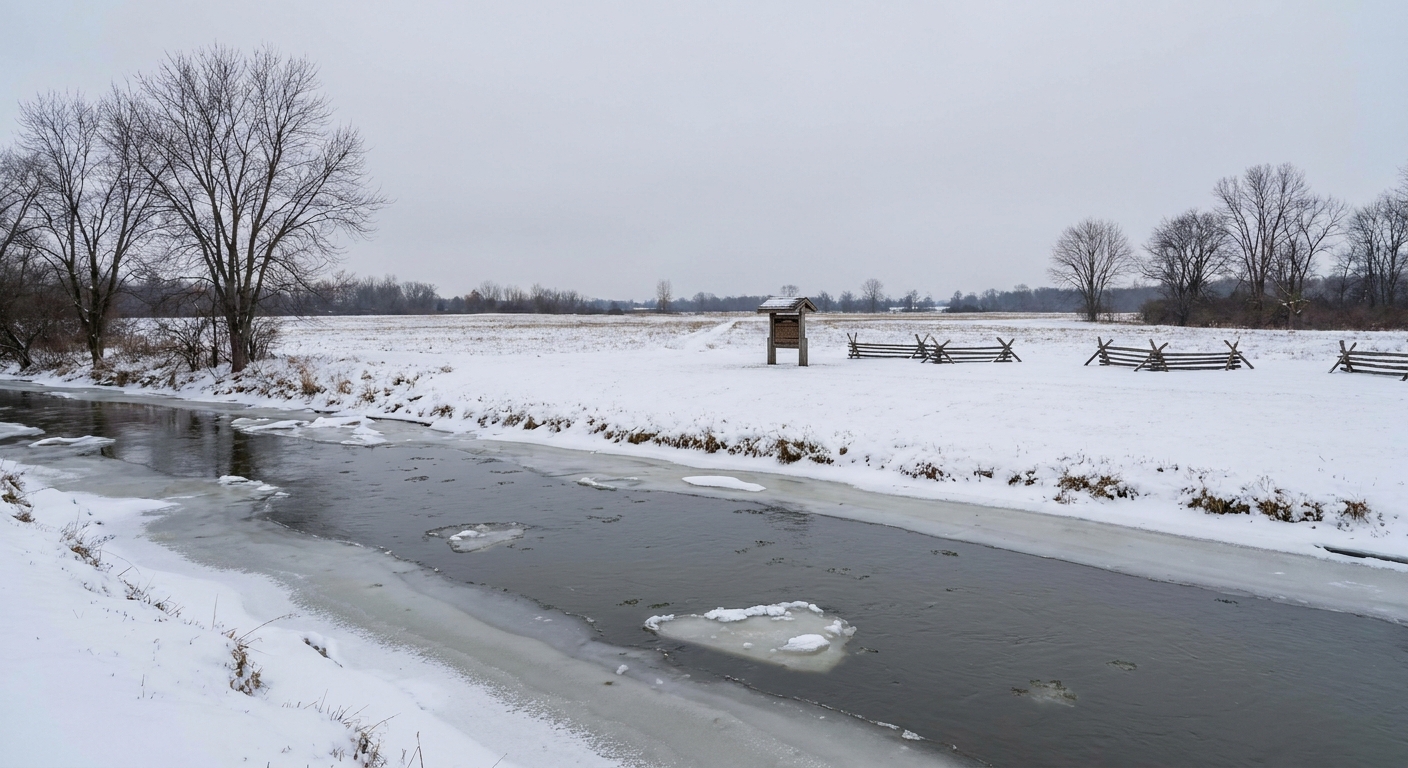
Before you go: hours and programming can vary by season, so plan with flexibility. Parking is generally centered at the visitor center, and the site is easy to cover on foot in a short visit. The footprint here is small, and the modern landscape has changed since 1813, but the visitor center exhibits and outdoor markers do the work of connecting today’s quiet ground back to a winter battlefield.
Get your bearings
You will get the full story inside the visitor center, but it helps to arrive with a clear mental map.
- Setting: Frenchtown, a settlement along the River Raisin, southwest of Detroit.
- Why it mattered: control of this corridor affected supply lines, alliances, and the push and pull around Detroit and the northwest frontier.
- Who fought: U.S. troops under Brig. Gen. James Winchester faced British regulars under Brig. Gen. Henry Procter, Canadian militia, and a coalition of Native nations allied with the British.
- What happened: U.S. forces initially retook Frenchtown, then on January 22, 1813, the British-led force struck back. The American line collapsed after intense fighting. By many commonly cited totals, roughly 397 U.S. soldiers were killed in the battle itself, making it the deadliest single-battle loss of American life in the War of 1812. Many others were captured in the collapse and surrender.
- What followed: on January 23, some wounded prisoners left in Frenchtown were killed, while others were taken away. Accounts vary, but the number killed in this post-battle violence is often described as roughly 30 to 100. The violence, looting, and chaos of that day quickly became “the Raisin massacre” in American newspapers and political speech.
- Aftermath: “Remember the Raisin” became a rallying cry, especially associated with volunteers heading back into the Northwest later in 1813, as the war’s bitter frontier logic continued to grind on.
If you want a broader sense of how war memory and politics intertwine afterward, I have always found it helpful to zoom out to what soldiers and citizens did with their wartime experiences later. Our piece From the Battlefield to the Ballot Box is a good companion read once River Raisin gets under your skin.
Start inside
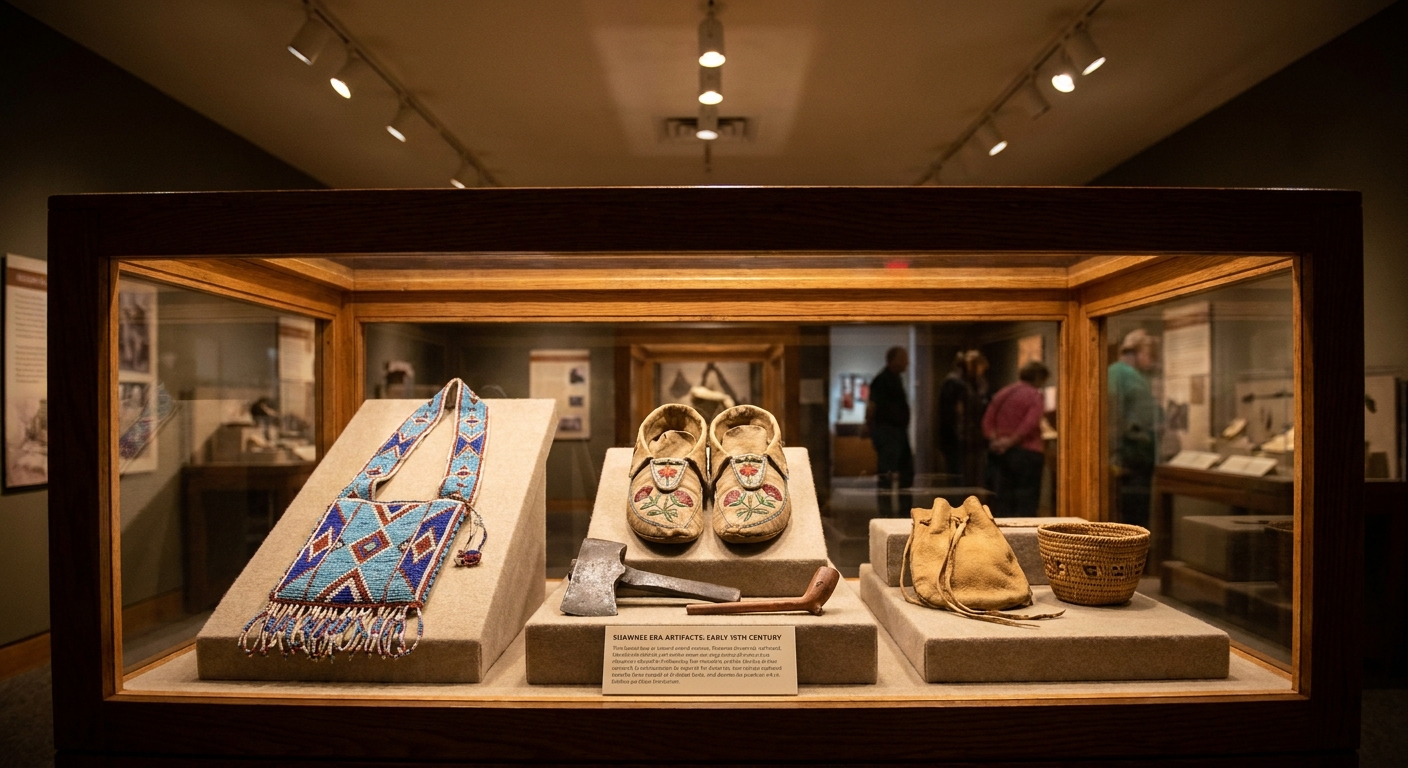
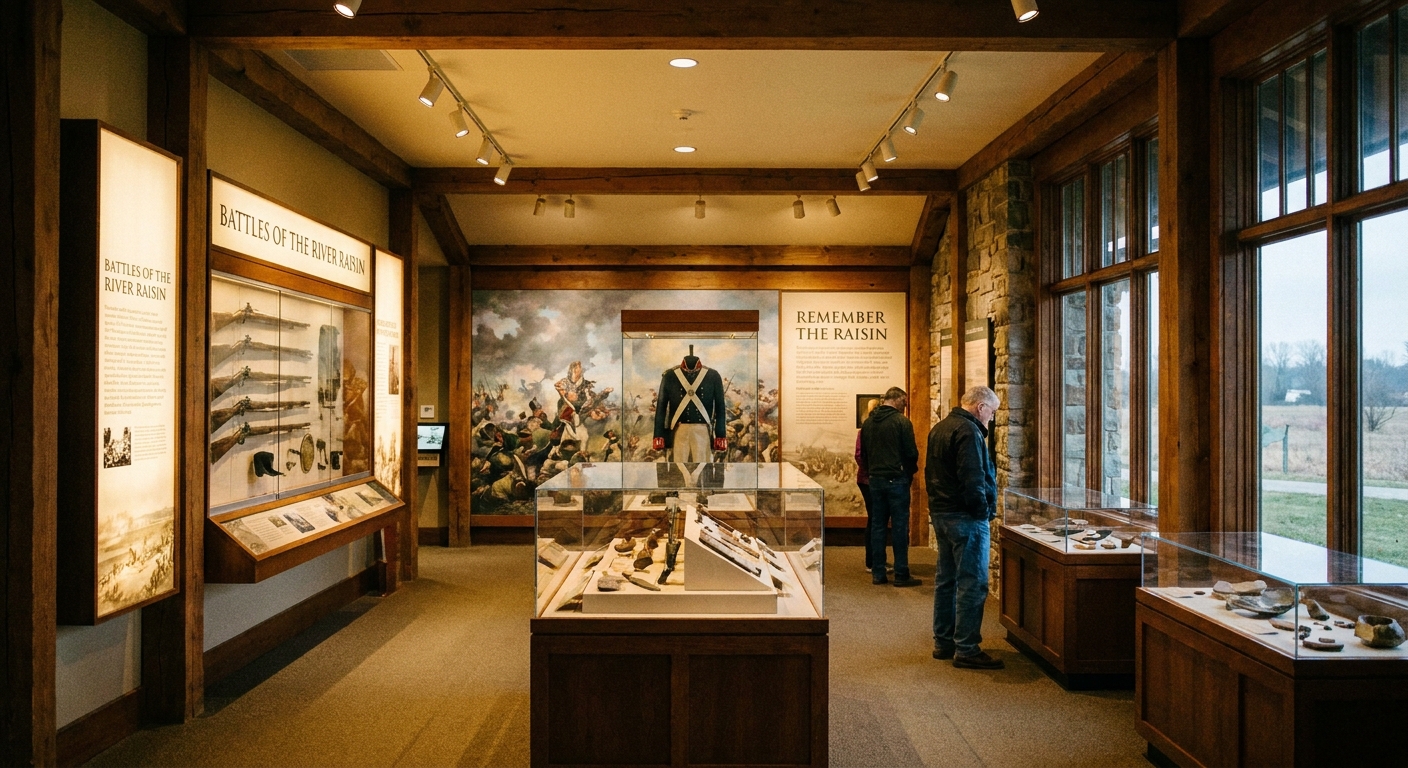
If you only have an hour at River Raisin, spend most of it in the visitor center. The park is one of the best places in the region to understand the human stakes of the northwest frontier. Do not rush it like a quick roadside museum. Treat it like a conversation with people who lived through a winter disaster.
1) Frenchtown as a community
Look for anything that anchors Frenchtown as a living place before it became a headline. The War of 1812 is often told as flags and forts, but this was also a town of families, trade, language and religion, and complicated loyalties. When armies collide in a settlement, the battle does not start at dawn and end at dusk. It leaks into barns, kitchens, and back rooms.
As you read panels about the community, ask yourself two questions:
- Where would you have tried to hide? Not heroically, just practically.
- What would you have lost first? Food, shelter, a horse, a family member, your sense of safety.
2) The collapse
Most visitors come in expecting “a battle, then a massacre.” What the exhibits do well is show how quickly a battle can become a rout when lines break, ammunition fails, commands fragment, or units lose cohesion. Track the timeline and pay attention to the geography references. River, fences, buildings, and winter ground conditions all shape the speed of disaster.
3) What surrender meant
In some wars, surrender is the clean end of a fight. On the northwest frontier in 1813, surrender could be the beginning of the worst part of your day. Pay attention to how prisoners were handled, where they were moved, and what “left behind” actually looked like in practice. This is where the exhibits start to explain why the public reaction was so explosive.
For a different angle on captivity and confinement in the period, our deep dive Inside Dartmoor Prison shows how imprisonment could become its own battlefield, even far from the frontier.
4) “Remember the Raisin”
Do not treat the slogan as a catchy line. In the exhibits, you can watch it harden from grief into marching fuel. Four words that could be repeated around a campfire, on a road, or in a tavern, and still carry the weight of what happened here.
As you read, notice how the park frames this as a public turning point. River Raisin sharpened attitudes for the rest of the war in the Old Northwest.
Step outside
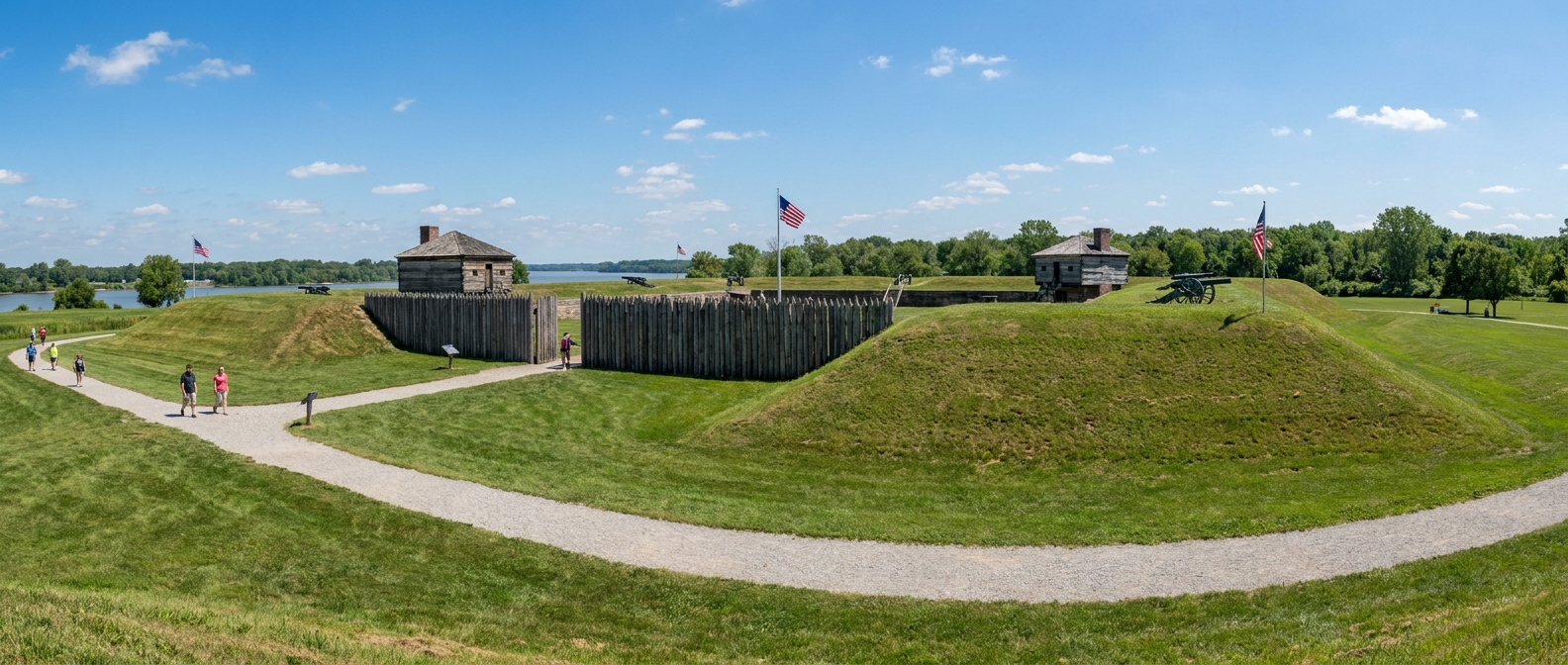
Outside, River Raisin can feel deceptively ordinary. That is exactly why you should slow down. Because the battlefield landscape has been altered over time, the interpretive markers are not just signs. They are your map back into 1813.
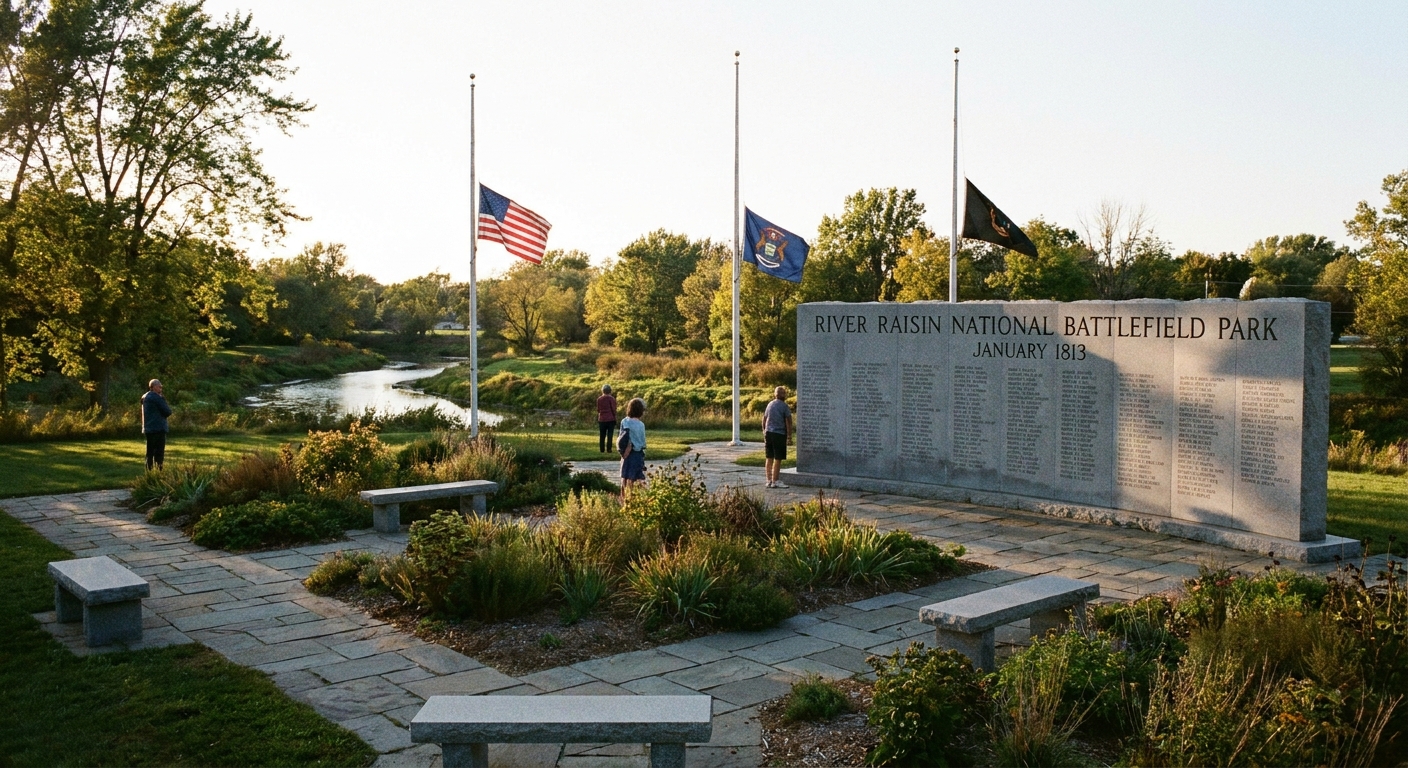
What you will physically see today is straightforward and worth naming: a short network of paths, interpretive panels, and memorial elements that help you place the fighting and the aftermath in a modern town setting.
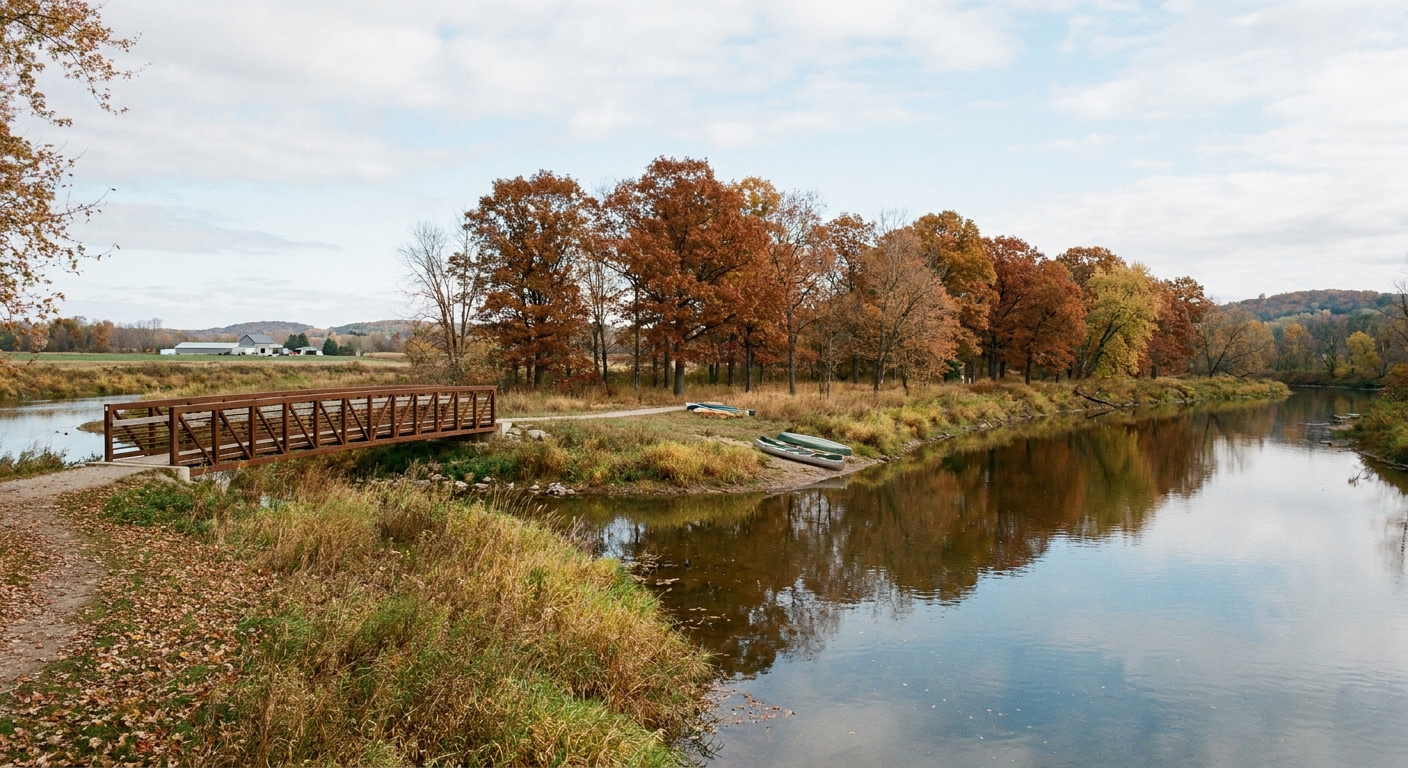
1) The river
Spend a few quiet minutes simply watching the River Raisin move. Rivers in the War of 1812 were highways and walls at the same time. In winter, ice and mud change everything: speed of movement, where men can run, where artillery can roll, where wounded can be carried.
When you look at the water, think like an exhausted soldier:
- How do you cross it under fire?
- How do you retreat when the bank is slick and crowded?
- Where do prisoners get gathered, guarded, marched?
2) The tight scale
River Raisin is not a mountaintop battlefield with panoramic hero views. It is intimate. That intimacy is part of what stays with people. Use the markers and pathways to picture how quickly musket fire would have reached into spaces where wounded were sheltered.
If you have ever visited a fort and felt how tight the walls make the air, it is a similar sensation, just without the comforting geometry. For a strong fort comparison day-trip style, see our Fort George Visitor’s Guide.
3) Memorial spaces
Take your time at memorial elements and interpretive text. I always tell myself, out loud if no one is near, that these were people who had to eat, sleep, and shiver. Some had written home weeks earlier about trivial things: socks, pay, boredom, a cough that would not quit. Then they were here.
When you read about the wounded left in Frenchtown, try to hold two truths at once:
- Military reality: armies move, guards are limited, command priorities can be brutally narrow.
- Human reality: the wounded experience time differently. An hour can feel like a day. A day can feel endless.
Understanding the killings
River Raisin is sometimes introduced to visitors with one grim shorthand: “the massacre.” The park does not let you stay in shorthand for long, and neither should you.
Keep the sequence straight
The violence after the battle did not occur in a vacuum. It grew out of battle conditions, confusion, custody, and a frontier war where alliances and obligations did not match American expectations. Some prisoners were marched away. Some wounded were left behind. In that gap, the worst kind of decision making, rumor, vengeance, and opportunity can take over.
If you are trying to keep your facts tidy, separate the story into two parts: the defeat and mass capture on January 22, and the killings of some wounded prisoners on January 23. The visitor center does a good job helping you keep that line clear.
Watch the words
You will notice that different accounts use different language. Some descriptions were written with raw grief. Others with political intent. The visitor center materials generally do a good job of signaling how memory and message can intertwine.
If you like to test your own understanding as you travel, try summarizing River Raisin in two clean sentences:
- U.S. forces suffered a major defeat at Frenchtown in January 1813, with catastrophic battlefield losses and large numbers captured.
- The killing of some wounded prisoners the next day became a rallying point in the Northwest, carried forward in the cry “Remember the Raisin.”
A walking rhythm
If you want the visit to land emotionally and intellectually, here is a rhythm I use at many 1812 sites, especially compact ones like River Raisin.
- Visitor center first: learn names, forces, alliances, and the timeline.
- Grounds second: walk slowly and let scale correct your imagination.
- Back inside for ten minutes: revisit one exhibit with the landscape now in your head.
That last step is the difference between “I saw it” and “I understand it.”
Where to go next
River Raisin is a hinge point for the northwest frontier. To see how different theaters of the war produced different kinds of suffering and resolve, these reads pair well without pulling you away from the human scale.
- Weapons of the Thames, for a tangible feel of how men fought and what they carried into battle.
- Life After Tecumseh, for the longer shadow cast by the war in Native communities and frontier politics.
- Historic Sites Guide, if you are building a road trip that mixes forts, battlefields, and places where civilians lived through occupation and fear.
Quick visitor questions
Is River Raisin the war’s deadliest fight?
For U.S. forces, it is often cited as the deadliest single battle of the War of 1812, with roughly 397 Americans killed in the fighting on January 22. When people add the post-battle killings on January 23, the human toll feels even heavier. Because totals can vary by source and definition, I treat River Raisin as a place of catastrophic American loss, and a reminder of how quickly defeat, captivity, and violence can pile up in a frontier war.
How long do you need?
You can get the essentials in 60 to 90 minutes. If you want the story to settle, give it two hours and do the visitor center twice, before and after walking outside.
What about fees and accessibility?
I avoid guessing on fees and access details because they can change, and because readers deserve accuracy on logistics. What I can say from the feel of the site is that it is a compact NPS visit with visitor center exhibits and short outdoor walking, so it tends to work well for a wide range of ages and energy levels.
Is it appropriate for kids?
Yes, with guidance. The subject matter is heavy. I have seen families do well by focusing on the ideas of community, consequences, and remembrance, then deciding how much detail to discuss based on age.