
The first time I walked into Fort George, I was expecting a clean, tidy “here’s the old fort” experience. Instead, I got something closer to the Niagara frontier’s true character: a place battered hard in 1813, occupied, and then overtaken again as the campaign slid into its ugly winter phase. The War of 1812 here was not one big moment. It was a rough, repetitive grind of cannons, orders, mud, and anxious civilians watching which flag would be flying next.
This guide is built for visitors who want more than a quick lap around the palisade. We will trace the 1813 American occupation of Niagara and use the fort’s reconstructed buildings and earthworks to understand the brutal back-and-forth that made this borderland feel like it was always on a knife edge.
Get oriented: why Fort George mattered
Fort George sits near the mouth of the Niagara River, where the Niagara River flows out of Lake Ontario into a fast corridor of water, supply, and ambition. In 1812 and 1813, controlling this tip of the peninsula meant controlling movement along the river and pressuring the enemy’s shore. Across the water stood Fort Niagara, close enough to feel like an argument you can never finish.
In the war’s earliest phase, the Niagara frontier became a revolving door of raids, sieges, and counter-sieges. If you want the broader context for how individual fights fit together, the site’s War of 1812 timeline and battles guide help you anchor what you are seeing at Fort George to the larger campaign.
Know this: what you see is reconstructed
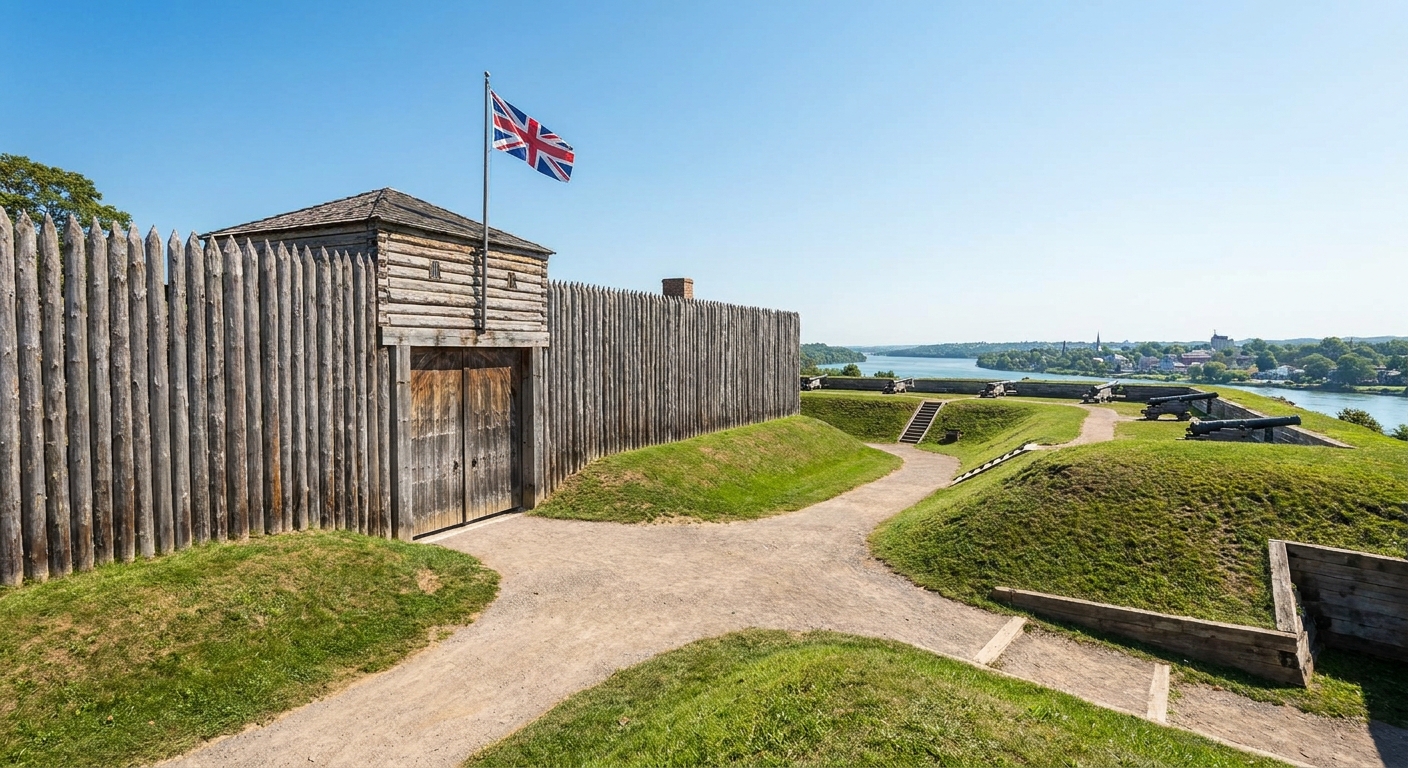
Most visitors learn this five minutes too late, so I like to put it up front. Fort George today is a reconstruction intended to interpret the War of 1812 era. The layout and key features are informed by archaeology, period plans, and documentation, but you are not walking through an untouched survivor. You are walking through a careful, physical argument about how the fort functioned and why it mattered.
Treat that as a strength. Reconstruction makes the fort legible. It gives you scale, sightlines, and the sense of confinement that paper diagrams cannot.
The 1813 occupation in brief
If you want the bones of the story before you start wandering, here is the cleanest way to hold it in your head.
- May 1813: American forces bombard Fort George heavily, then land and press the position. The British garrison withdraws toward Burlington Heights rather than offering a formal, ceremonial surrender at the fort.
- Summer 1813: The Americans occupy Fort George and try to use it as an anchor on the Niagara line. The fort becomes a working base, which means constant supply pressure, fatigue, sickness, and a local civilian population caught in the machinery.
- Mid to late 1813: The wider frontier turns unstable. As momentum shifts, holding Fort George becomes harder than taking it.
- December 1813: U.S. forces evacuate and abandon Fort George as their Niagara position collapses under pressure and hard command choices. Days later, British forces cross in a night assault and capture Fort Niagara. The winter sequence that follows includes raids and burnings on the American side, while British control reasserts itself along this stretch of the river.
That is the “trace” in a nutshell. When you walk the site, you are basically walking through the logistics of that summer occupation and the uneasy knowledge that it would not last.
The 1813 story on the ground
May 1813: bombarded and evacuated
By late spring 1813, American forces had set their sights on the Niagara line. Fort George came under heavy bombardment. When you stand on the ramparts today, try to imagine the sound not as a single blast, but as hour-after-hour pounding that shakes your teeth. Fortifications are comforting on a calm afternoon. Under sustained fire, they become a trap you cannot leave without being seen.
And the end of the fight was not a neat capitulation scene. The British garrison largely withdrew from the fort and fell back toward Burlington Heights, leaving the Americans to occupy ground that had been made costly to hold.
Occupation: taking is not holding
The American capture of the position was followed by occupation, and occupation is where the human story turns gritty. Armies need food, fuel, and safe storage. They need wagons, horses, carpenters, and labor. That pressure does not fall on a map. It falls on nearby farms, storehouses, and families who are already stretched thin.
Fort George’s interior spaces, even in reconstruction, are excellent at showing the difference between “we took the place” and “we can sustain the place.” Look for how the layout funnels people into controlled lanes: gates, parade ground, barracks lines, and magazines. It is a working machine, and occupation forces that machine to run constantly.
December 1813: the line breaks
The Niagara frontier’s story is not a victory lap for either side. By mid-December 1813, U.S. forces had already evacuated and abandoned Fort George as the Niagara line contracted under supply strain, battlefield setbacks, and the blunt reality that the post could not be held safely. Only after that did the British night assault take Fort Niagara on December 18 to 19, followed by a punishing run of raids and burnings along the river.
Fort George sits inside that chain of events like a hinge. It helps you feel how quickly a “secure” post can become a temporary perch.
What to see at Fort George
1) Ramparts and batteries
Start by walking the earthen ramparts slowly. Earthworks are not dramatic like stone walls, but they are brutally practical. Packed earth absorbs shock better than masonry, and it can be repaired faster. If you only have time for one interpretive exercise, do this:
- Pick a likely direction of threat and note the lines of fire from gun platforms.
- Look for dead ground, the spots an enemy could approach with less exposure.
- Notice how the ramparts limit your view even when you are “on top.” Forts protect, but they also blind.
In 1813, these angles were life and death arithmetic. Range, reload time, smoke, and discipline mattered as much as courage.
2) Palisade and gates
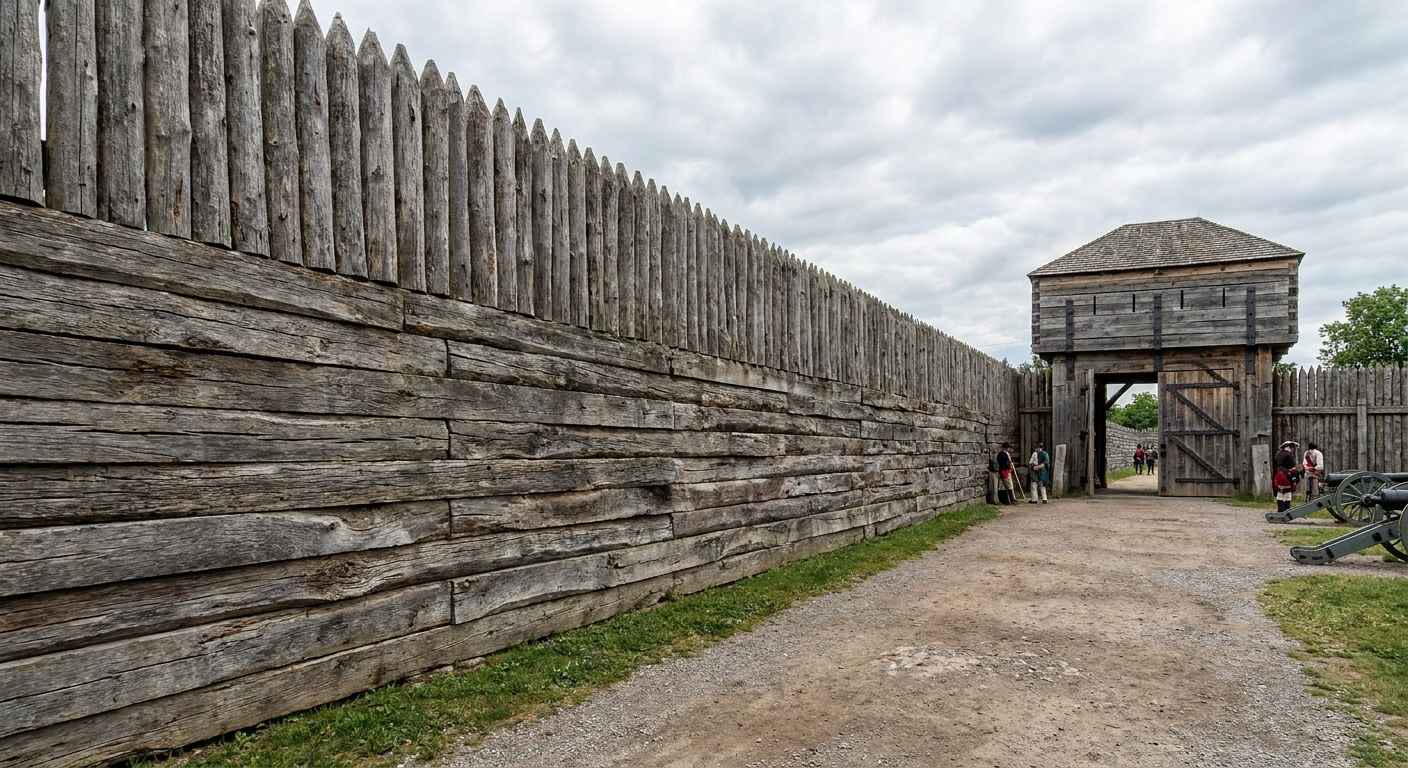
Wooden palisades can look quaint to modern eyes. In wartime, their job is to delay, channel, and identify. Gates are chokepoints. During occupation, they are also a kind of paperwork made physical: who gets in, who gets searched, who is carrying food, and who is carrying rumors.
3) Barracks and quarters
Barracks are where the war becomes repetitive. Soldiers sleep, eat, mend clothing, nurse blisters, and swap information. On a frontier like Niagara, the barracks also become a sponge for stress: boredom punctured by alarms, sickness moving through close quarters, and the constant problem of supply.
When you step inside reconstructed rooms, watch for the small things, because they are the truest: where damp clothing would hang and where smoke would have to go before the air felt used up.
4) Powder magazine
If there is a single structure that explains why forts behave the way they do, it is the magazine. Powder storage demands rules: distance, discipline, and controlled access. In an occupation, the magazine becomes even more central because it anchors the garrison’s ability to respond quickly. A fort with empty powder barrels is just a fenced enclosure.
5) Parade ground
The open central space is easy to underestimate. In practice it is a tool. Drill turns frightened people into coordinated movement. Muster lets officers count who is present and who is missing. Parades project confidence to anyone watching, including local civilians deciding whether it is safe to bring a cart of produce near the gates.
How to read a contested border
Fort George today is reconstructed, and that is not a weakness if you treat it honestly. Reconstruction is an argument about what mattered. The very act of rebuilding forces choices: what to show, what to prioritize, and what to leave as open ground.
Here is how to read the site with the 1813 occupation in mind:
- Materials and vulnerability: Wood structures and palisades remind you how quickly fire could rewrite a community’s map.
- Spacing and safety: Separation between buildings is not aesthetics. It is often about fire risk, powder safety, and controlling movement.
- Workflows: A fort is a logistics organism. Kitchens, storage, guard posts, and command spaces are arranged to feed routine and react to crisis.
If you have visited other reconstructed sites, you may notice a similar “cleanliness.” My trick is to mentally add what is missing: stacks of split wood, slop buckets, wet wool drying in clumps, and the pressure of an overcrowded sick room. The geometry is meant to be representative of the period, but the lived experience was never neat.
A simple walk: 60 to 90 minutes
- Begin at the entrance and pause before you go in. Picture a guarded gate during occupation. Who is allowed through, and who is turned away?
- Do a rampart loop first. Get the fort’s shape into your legs and your sense of direction. Identify the most commanding views and the most sheltered approaches.
- Drop into the magazine area. Think about rules and risk, and how a single accident could cripple the garrison.
- Move through barracks spaces. Ask how many people could realistically live there for weeks and months, and what happens to morale as supplies tighten.
- Finish at the parade ground. Stand still and listen. A fort is built to amplify commands. Imagine the soundscape: boots, orders, distant guns, and the constant river wind.
Pair it with nearby stops
The Niagara frontier makes the most sense when you treat it as a connected landscape rather than isolated attractions. If you are building a weekend itinerary, these pieces help complete the story:
- Queenston Heights vs Lundy’s Lane for a clear, ground-level sense of how the border stayed contested.
- Historic sites guide to stitch Fort George into a wider map of 1812 places worth your time.
- Tips for attending reenactments if your visit overlaps with living history events and you want to get more out of what you are seeing.
Practical tips I wish I had
- Do the ramparts early or late. Midday sun and open slopes can make the walk feel longer, and the wind off the lake tends to be sharper than you expect.
- Wear shoes you trust on uneven ground. Earthworks, wooden steps, and grassy slopes can be slick after rain.
- Expect some accessibility limits. Ramps and flatter routes may exist, but earthen works and historic layouts mean uneven grades are part of the experience.
- Give yourself quiet time. The fort is at its most revealing when you slow down and let sightlines and distances do the explaining.
- Interpretation varies by season. Staff programs, demonstrations, and open buildings can change across the year, so stay flexible and build your visit around what is available that day.
- If you are traveling with kids or first-timers, pick one story thread. For this site, I recommend “occupation life”: food, sleep, sickness, discipline, and fear.
Visitor questions
Was Fort George destroyed?
Fort George was heavily damaged in the 1813 bombardment and then caught up in the wider destruction that swept the Niagara frontier later that year. The fort you visit today is reconstructed to interpret the period and help you visualize what stood here during the fighting and occupations.
How long did the Americans occupy Fort George?
The American occupation began after the position was taken in late May 1813 and effectively ended when U.S. forces evacuated and abandoned it in mid-December 1813. When you tour the site, it helps to think in terms of a tense summer and fall rather than a calm, long-term hold. On this frontier, stability was the rarest resource.
What if I only have 30 minutes?
Do the ramparts and one interior building. The ramparts explain how the fort fought. One interior space, especially a barracks area, explains how the fort endured occupation day to day.
Why it still feels personal
I grew up in upstate New York close enough to Niagara that the place names felt like neighbors. My grandfather used to stop at forgotten markers on weekend walks and tell me, quietly, that history is often just people trying to get home in one piece. Fort George is one of those places where that lesson sticks. You can admire strategy here, sure. But the fort’s real power is how clearly it shows the cost of repeated “winning.” On a contested border, victory is often just a short lease.
If Fort George sends you down a rabbit hole, you will probably enjoy our broader Historic Sites coverage and the way it connects ground you can stand on to the people who had no choice but to stand here.