
The first time I drove out to Ohio’s old frontier forts, I expected tidy monuments and a few cannons posed for school field trips. What I found instead was something harder to shake: big, living earthworks that still hold the shape of fear and improvisation. Fort Meigs and Fort Stephenson were both critical defenses in 1813, but they feel very different as places to visit. One is sprawling and strategic, a whole landscape of angles and lines. The other is compact and personal, the kind of site where you can stand still and imagine exactly how close the fighting came.
If you are stitching together a War of 1812 road trip, here is how I think about these two forts, what each preserves best, and how to choose the experience that fits your time and curiosity.
Quick take: which fort should you visit?
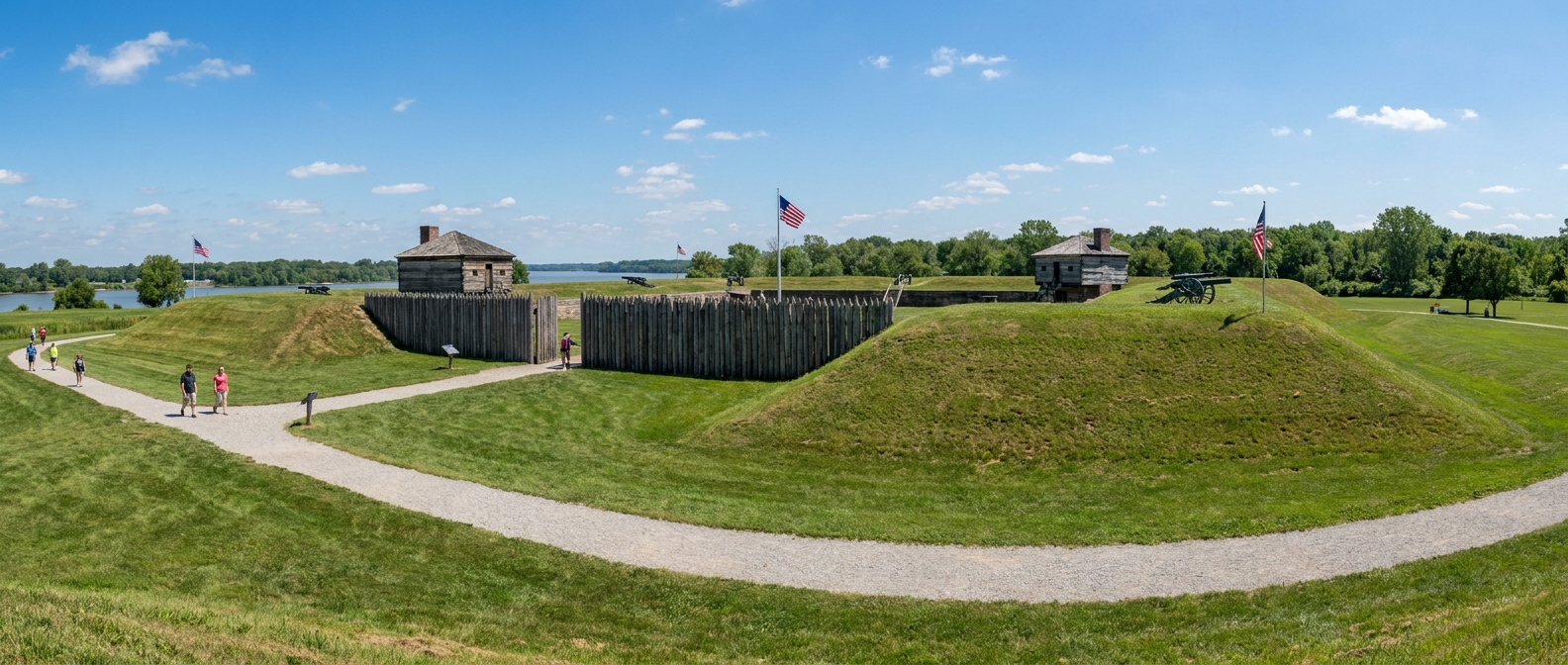
- Choose Fort Meigs if you want one of the largest preserved War of 1812 earthwork fortifications in the United States, lots of room to wander, and a strong sense of how an army tried to hold the Maumee River line.
- Choose Fort Stephenson if you want a smaller stop that hits hard, especially if you are interested in close-range combat, siege pressure, and the story of a defense that helped steady the Northwest after the losses at Detroit and the River Raisin.
- Do both if you can. They are a natural pairing because they show two different scales of the same problem: keeping a foothold in a region where roads were mud, supplies were fragile, and the British and their allies could appear fast.
For broader planning across sites, I keep a running list on our Historic Sites guide, and if you want the military story stitched together by dates, the timeline helps place each fort visit in sequence.
What happened here, in plain language
Fort Meigs: holding the Maumee line
Fort Meigs was built to anchor the American position in northwest Ohio after the early-war chaos. In 1813 it became the focal point for British efforts to break that position, with two major siege periods that tested the fort and the men inside it.
As a visitor, the key idea is scale. Fort Meigs was made to hold a lot of people and a lot of supplies, and its shape reflects that. You do not just “see a fort.” You walk the footprint of a campaign headquarters on the edge of a contested region.
Fort Stephenson: Lower Sandusky, today’s Fremont
Fort Stephenson sat at Lower Sandusky on the Sandusky River, in what is now Fremont, Ohio (not the city of Sandusky on Lake Erie). It is remembered for a determined defense during a British assault on August 2, 1813, when a small garrison refused to fold under pressure.
As a visitor, the key idea is proximity. The fighting feels closer to the skin at Fort Stephenson, and the site’s compactness helps you understand how quickly a situation could go from tense to catastrophic.
The visit: how each site feels
Fort Meigs feels like a landscape
At Fort Meigs, the walk is the point. Earthworks rise and fall in long lines, and the fort’s footprint encourages you to move, stop, and reorient yourself the way an officer would have, checking angles, distances, and approach routes. Even on a quiet day, wind and birds and the sheer openness make it easier to imagine long watches and anxious waiting.
- Best for: people who like walking routes, big sight lines, and thinking in terms of terrain.
- What you will remember: the sense that “this was built in a hurry, but it was built big.”
Fort Stephenson feels like a moment
Fort Stephenson is a quicker visit, and that is not a knock. Its strength is focus. You are not absorbing a massive defensive complex. You are trying to picture a smaller garrison bracing for impact, counting shots, and making decisions while smoke and noise press in.
- Best for: travelers with limited time, families who want a clear story, and anyone drawn to the human scale of a defense.
- What you will remember: how little ground there is between “outside” and “inside.”
Earthworks: what to look for
Fort Meigs: earthworks you can read
Fort Meigs is where Ohio’s frontier war becomes tactile. The earthen walls are not just background scenery. They are the artifact. When you walk them, you are walking the engineering choices that shaped survival.
What I look for at Fort Meigs:
- Long runs of embankment that show the fort’s size and how much labor went into moving dirt.
- Angles and corners that remind you the defenders were thinking about lines of fire, not beauty.
- Low ground and approach routes where you can imagine how attackers might probe and where defenders had to watch hardest.
Fort Stephenson: tight defenses, short distances
Fort Stephenson does not overwhelm you with sheer scale. Instead, it teaches distance. It is a good site for standing still and asking: “If I were inside, what can I see? If I were outside, how exposed am I?”
What I look for at Fort Stephenson:
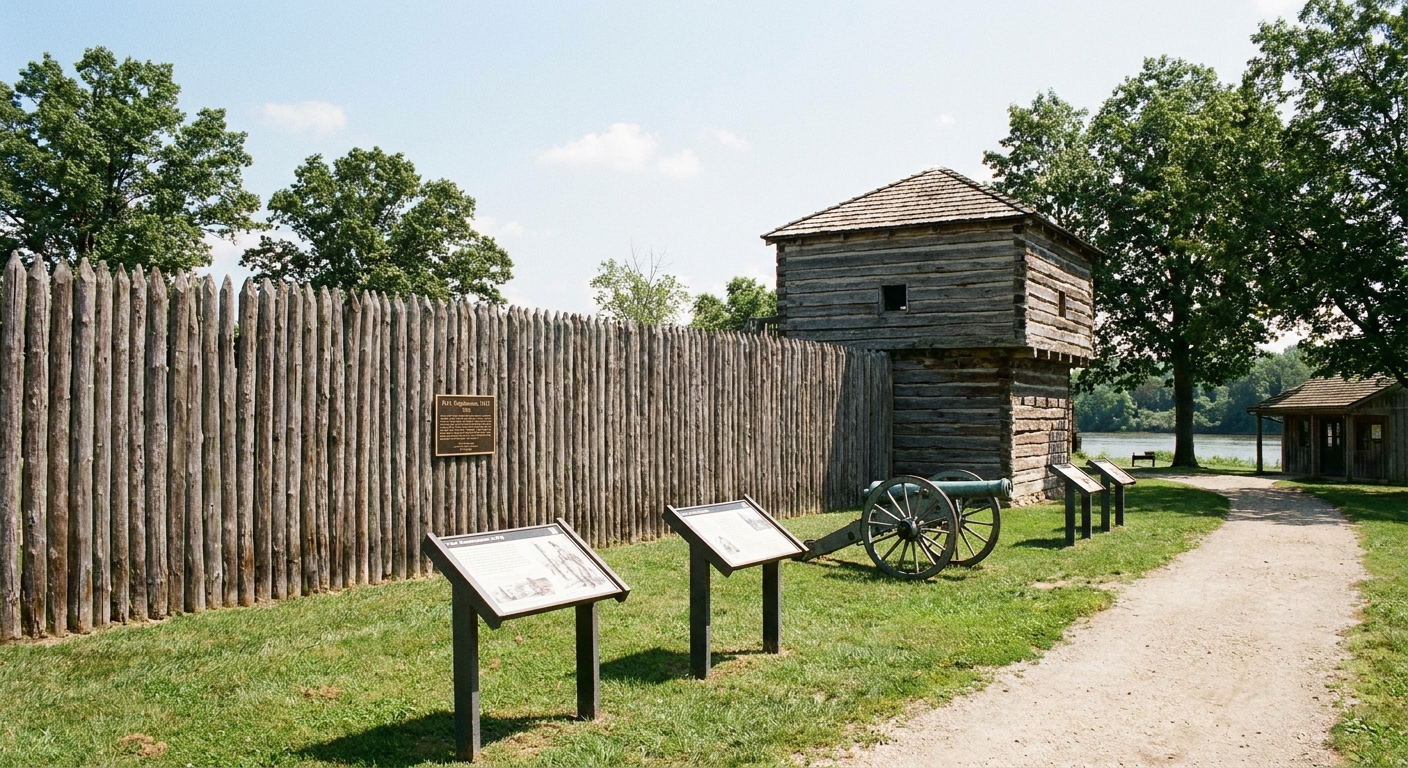
- The fort’s tight footprint, which clarifies how compressed a defense could be.
- The relationship between the fort and the surrounding ground, especially sight lines and cover.
- Any surviving or reconstructed elements that help you visualize palisade height and the feeling of enclosure.
Museums and exhibits: what you will learn
Fort Meigs: campaigns, logistics, supply
Fort Meigs is a natural place to learn the “why” of the Northwest theater. Why the Maumee mattered. Why holding a position could be as important as winning a battle. Why supply and weather could be as deadly as enemy fire. Even if you arrive knowing only the broad outline, it is a good site for turning the war back into a practical problem: food, powder, morale, and time.
If you have read about Great Lakes naval efforts, Fort Meigs pairs well with the idea that victories were built long before cannon fire. I always think of the hard work behind the scenes described in Perry’s shipyard miracle before Lake Erie, because it comes from the same world of rough logistics and urgent improvisation.
Fort Stephenson: the drama of defense
Fort Stephenson’s interpretive strength is clarity. A smaller site often tells a tighter story, and that usually means you leave with a clean understanding of who was there, what they faced, and why the defense mattered. It is also a good place to connect names to the ground, including the young commander George Croghan and the choices a small garrison had to make when the pressure finally arrived.
For visitors who sometimes feel lost in big campaigns, this kind of focused narrative can be the hook that makes the larger war click.
Road trip planning: time and pacing
How much time to budget
- Fort Meigs: Give yourself extra time for walking. If you like to read every sign and double back for a second look, you can easily turn it into a half-day stop.
- Fort Stephenson: Easier to fit into a day with other stops. It works well as a shorter, story-driven visit.
They are not next door
One practical note for planners: Perrysburg (Fort Meigs) and Fremont (Fort Stephenson) are close enough to pair, but not close enough to treat as a single combined site. Expect roughly an hour of driving between them, depending on your route and traffic.
What to bring (learned the hard way)
- Good walking shoes, especially for Fort Meigs where the ground invites long loops.
- Water and sun protection. Earthworks do not provide much shade, and the weather can turn a pleasant stroll into a slog.
- A notebook or phone notes app. Jot down details that move you, like a quotation from an exhibit or a place on the wall where you suddenly understood the geometry of defense.
Before you go
Hours and programming can be seasonal at sites like these. I always check current hours and any special event calendars before I build the day around them, especially if I am hoping to catch living history or interpretive demonstrations.
If you can only do one day
If I had one day and wanted the fullest contrast, I would start with Fort Meigs for the big earthwork experience, then head to Fort Stephenson to end the day with a tighter, more personal story. The order matters because Fort Meigs sets your brain on “campaign scale,” and Fort Stephenson brings it back down to the level of individual decisions.
How these forts fit the wider war
Ohio’s frontier defenses make more sense when you remember the war did not move at the speed of modern travel. Roads were often swamps. Rivers were highways. News traveled with riders and rumor, and sometimes the message you needed arrived late, incomplete, or wrong. When you stand inside an earthwork, you are standing inside a communications problem as much as a defensive one.
If you want to build a fuller itinerary beyond Ohio, two pieces on the site pair well with this frontier feeling:
- Weapons of the Thames, for a grounded sense of what soldiers carried and how close fighting actually worked.
- Life after Tecumseh, for the human consequences that continued long after the musket smoke cleared.
Fort Meigs vs Fort Stephenson: comparison
| Category | Fort Meigs | Fort Stephenson |
|---|---|---|
| Overall feel | Big landscape, long walks, strategic scale | Compact site, concentrated story, close distances |
| Best preserved feature | Earthworks and the fort footprint as a whole | Sense of tight defense and immediate threat |
| Great for | Terrain lovers, photography walks, big-picture context | Quick stops, families, anyone drawn to dramatic defense stories |
| Learning focus | Campaign logistics and holding a corridor | Decisions under pressure and what an assault feels like |
A quiet way to see both
When I visit sites like these, I try to spend one quiet minute doing nothing but listening. No reading. No photos. Just the sound of wind in grass and distant traffic, and the shape of the ground under my feet. It is a simple trick, but it helps me remember that these were not abstract “positions.” They were places where teenagers stood guard, where men tried to sleep sitting up, where someone worried about a feverish friend, where letters home were drafted with hands that still shook.
Fort Meigs teaches you what it took to hold a frontier line. Fort Stephenson teaches you what it felt like when that line narrowed to a few yards of dirt and timber. Together, they make Ohio’s 1812 frontier feel less like a chapter heading and more like a lived place.