
I first walked the ground tied to the burning of Washington the same way I learned most War of 1812 history: at a slow pace, eyes down, looking for what the big monuments do not say. My grandfather used to do that with me back home in upstate New York, stopping at half-forgotten markers and saying, “This is where the story turns.”
In August 1814, the story turned fast. People often remember the flames, but the real marvel is how quickly the machinery of government was shoved back into motion after the shock. What follows is a day-by-day timeline, not just of destruction, but of decisions, improvisation, and the practical work of keeping a nation running when its capital had been breached.
Before the fire
By the summer of 1814, the war’s rhythm had changed. With Napoleon defeated in Europe, Britain could spare more ships and veteran troops for North America. The Chesapeake became a pressure point: fast raids, sudden landings, and an uneasy sense that the next blow could land almost anywhere.
Washington was a tempting target for a raid and a psychological punch, but it was not a fortress city. Its defense leaned heavily on militia, short-notice marching orders, and a command structure that was too often scattered across overlapping jurisdictions.
If you want the immediate military lead-up, I keep a separate piece on the debacle at Bladensburg because it matters here: Beyond the Bladensburg Races.
Timeline: Aug 18 to early Sept
Note on timing: sources do not always agree on exact hours, and a day-by-day timeline can pretend at more precision than the record supports. What I’m giving you here is the clearest sequence most historians agree on, anchored each day to a specific action, person, or documented decision. When a detail is debated, I say so plainly.
August 18, 1814 (Thursday): The line of march takes shape
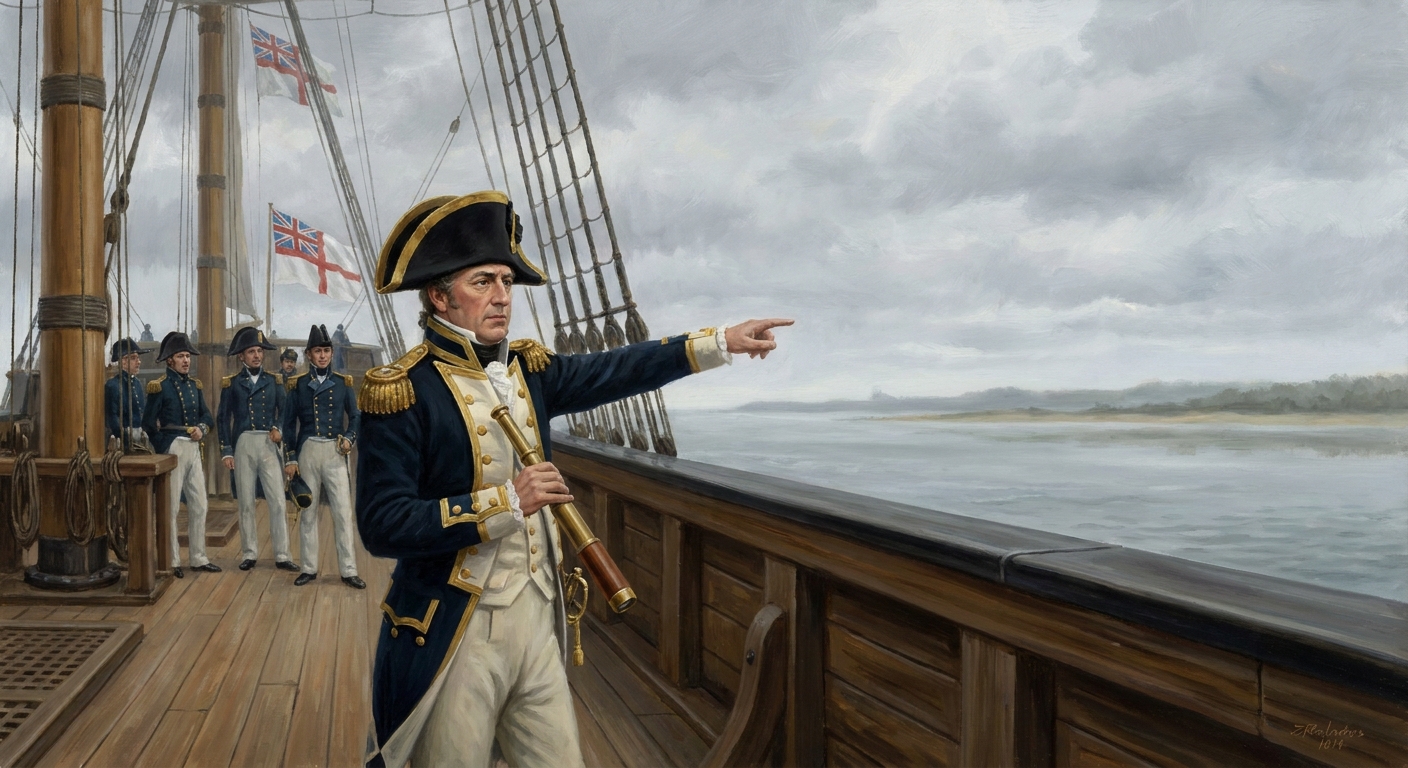
- Ross’s column pushes inland from the Patuxent corridor. The British thrust up the river system is no longer easy to shrug off as “just another raid.” Ross and Rear Admiral George Cockburn are moving with intent, with naval support keeping the whole operation fed and mobile.
- Washington stays militia-first. The defense is still an awkward mix: a small regular core, many militia units, and a command structure that can issue orders faster than it can enforce them.
- Quiet triage begins inside departments. In more than one office, the question is already practical: if the worst happens, what gets loaded into wagons first.
August 19 (Friday): Alarm spreads through the capital
- Madison rides the roads east of Washington to get eyes on the threat. The president’s personal reconnaissance trips, and the constant shuttling of messengers, underline how thin Washington’s information network really is.
- Federal clerks begin moving records out of easy reach. This is the early stage of what becomes a full scramble: trunks, satchels, and bundles carried to safer ground well before the British ever reach the city.
- Bladensburg becomes the name everyone repeats. Even before the battle, people talk about Bladensburg as the hinge point because it sits astride the approach routes to Washington.
August 20 (Saturday): Paper becomes freight
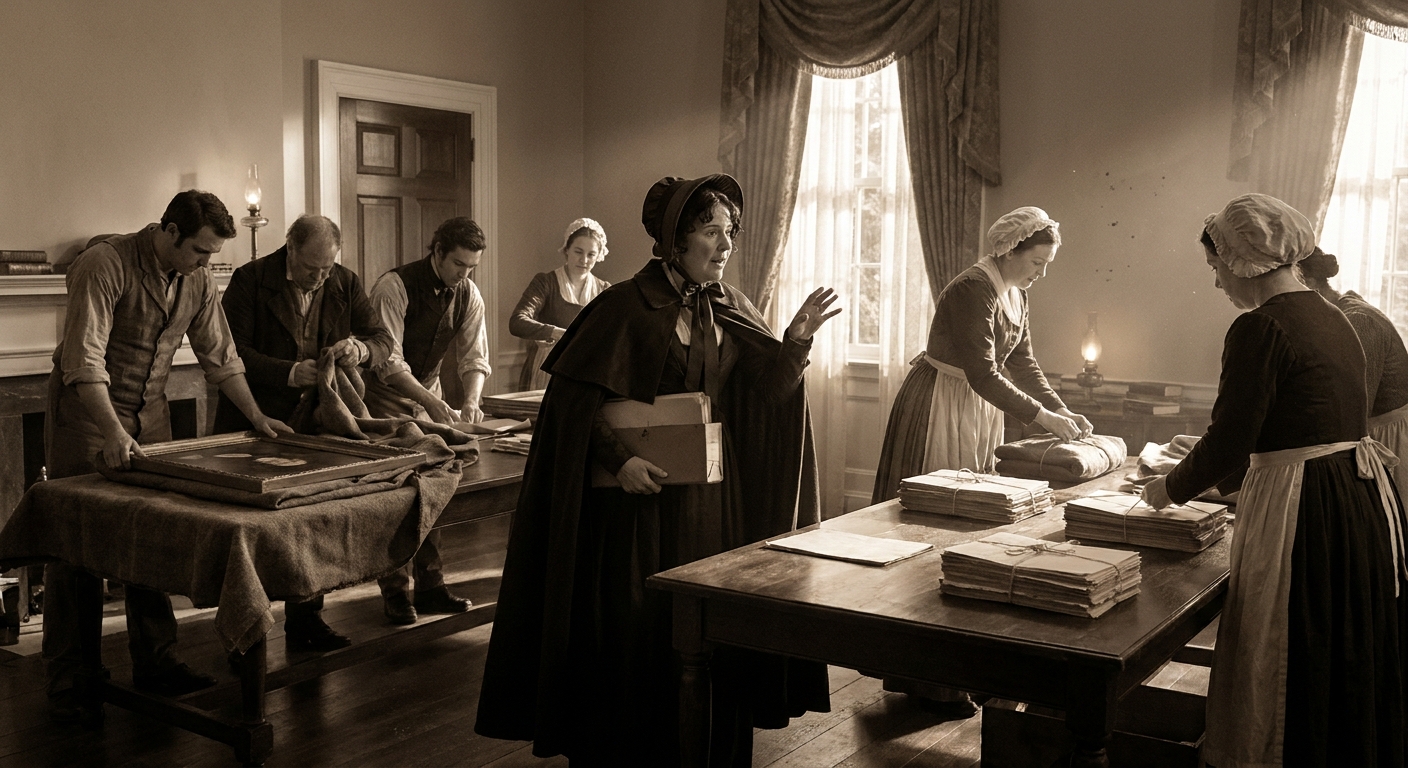
- State Department clerks start the hard work of relocation. Under the supervision of Chief Clerk Stephen Pleasonton, the department’s papers are packed for removal. It is not glamorous, but it is the sort of thing that makes a government more than a set of buildings.
- Wagons and carts become strategic assets. Anything with wheels is suddenly valuable, whether it belongs to an official or a shopkeeper.
- Rumor does what rumor does. Baltimore, Annapolis, and Washington are all discussed as possible targets, which means people prepare for the wrong blow until the right blow lands.
August 21 (Sunday): Flight plans and hiding places
- More families begin leaving Washington. The city is small, but it holds the paper heart of the republic: commissions, correspondence, accounts, treaty material, and the administrative memory of a young nation.
- Pleasonton’s evacuation effort expands. State Department records are moved farther from Washington’s center of gravity, a step that will matter in a matter of days when the capital is actually entered.
- The fear is not only fire. Capture of officials, seizure of records, and public humiliation are part of the threat picture. A raid can wound authority without holding territory for long.
August 22 (Monday): Bladensburg becomes the hinge
- American forces concentrate near Bladensburg, Maryland. The working hope is to stop the British before they can step onto Washington’s streets.
- Secretary of War John Armstrong remains skeptical. Armstrong’s doubts about Washington as a primary target are part of what makes this moment feel so brittle in hindsight, because the city needs decisive coordination and gets argument instead.
- Records continue moving. Clerks do not need a battle report to understand that paper burns.
August 23 (Tuesday): Final hours before impact
- British forces close in. Their advance is aggressive and confident, backed by veterans and supported by naval power along the waterways.
- Madison leaves Washington for the field. The president spends time with the forces assembling to meet the British, a choice that reflects both urgency and the absence of a clean, reliable command chain.
- Departments make last-minute choices. Hide items, move them, abandon them, or try to guard them. In crises, that is what policy looks like.
August 24 (Wednesday): Bladensburg and the burning
- Battle of Bladensburg. American forces are defeated outside Washington. The retreat becomes a rout in popular memory, later mocked as the “Bladensburg Races.”
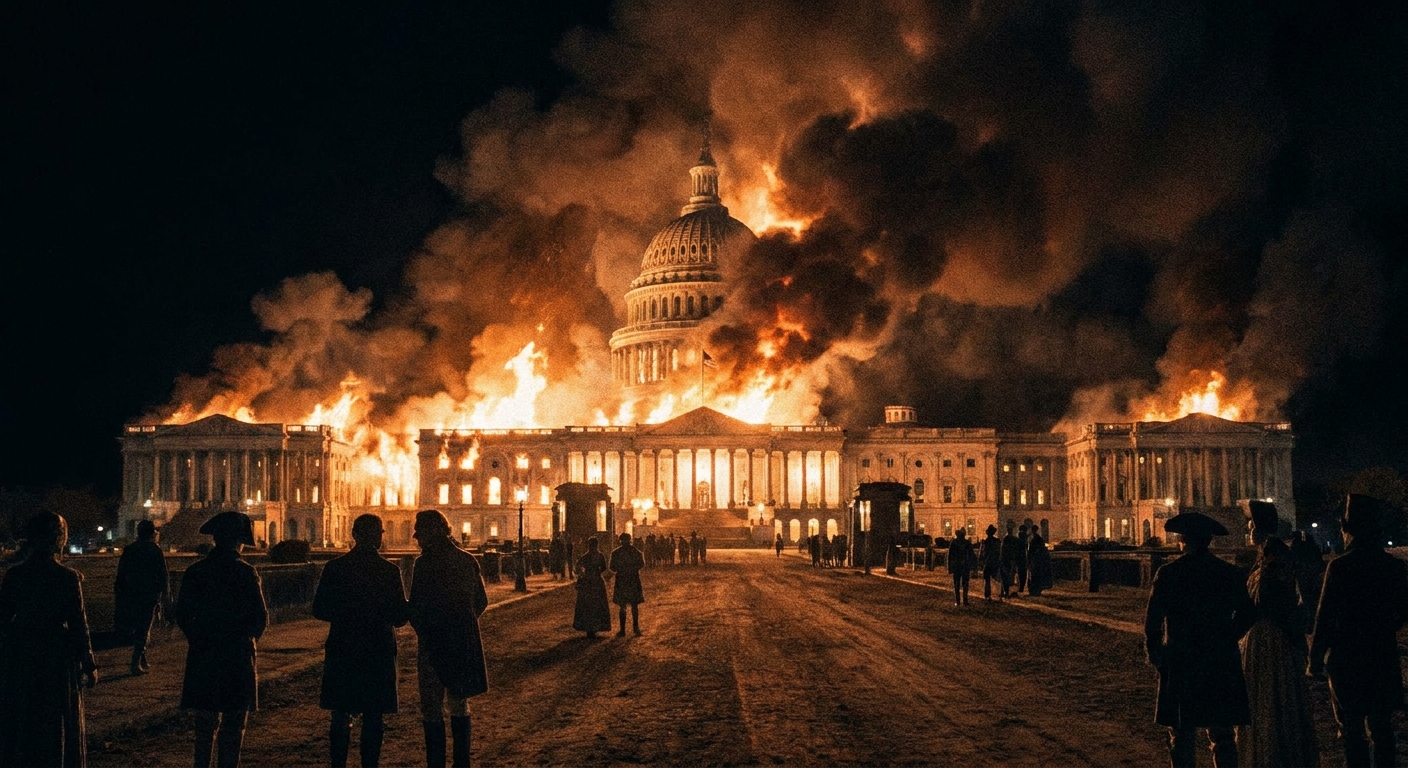
- Washington is open by evening. With the defensive line broken, British troops enter the capital that night.
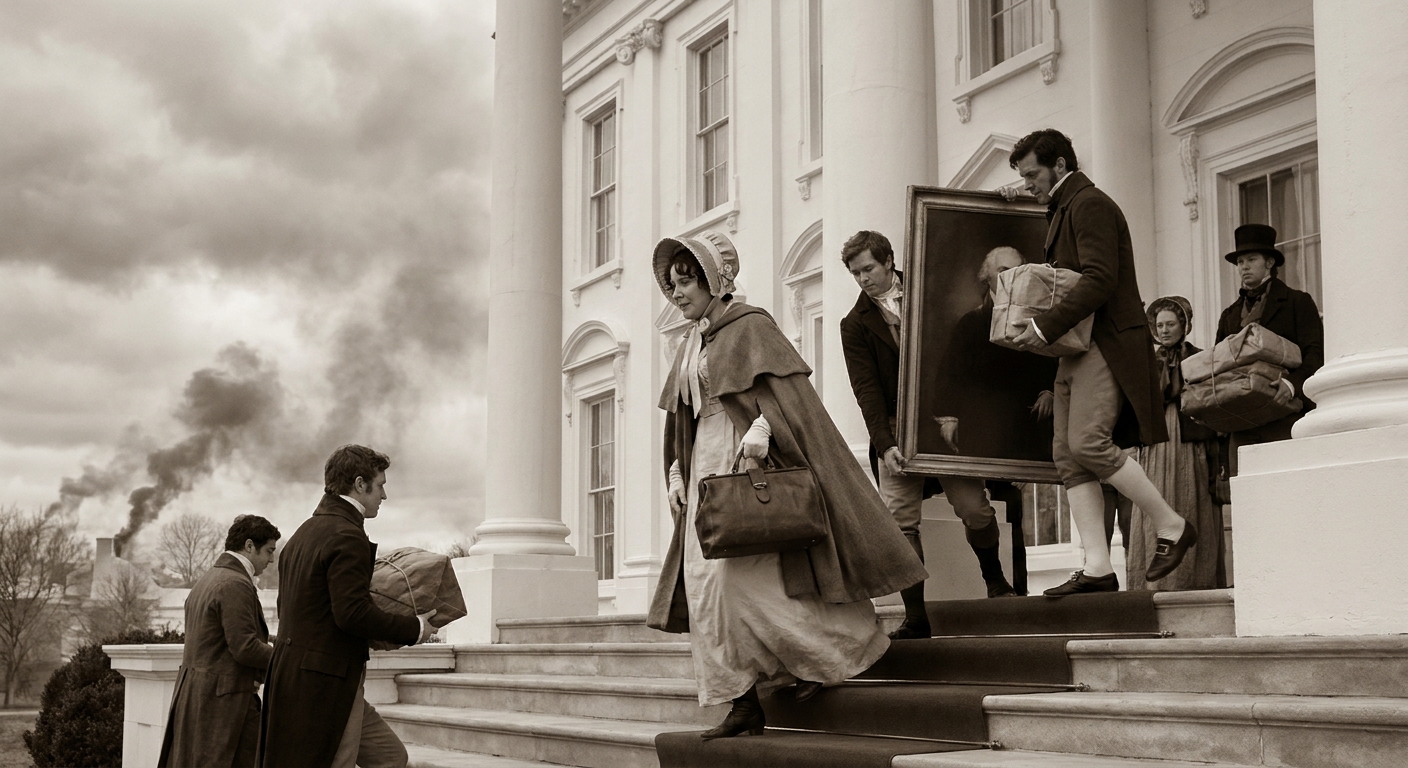
- Evacuation accelerates. Madison and other officials leave the city. Clerks scramble to protect crucial documents, official seals, and the working files that make authority real.
- Public buildings are burned. The Capitol (then still partly under construction) and the President’s House are among the targets. The destruction is aimed primarily at public authority rather than systematic house-to-house burning, though private property is not untouched by the chaos of a raid.
Two human details matter here. First, the evacuation was not tidy. It was wagons, damp heat, rumors, and roads clogged with people trying to outrun disaster. Second, the goal for many officials was not heroics. It was continuity: keep the papers, keep the seals, keep enough structure intact that the government can still act tomorrow.
For the most personal, famous slice of the evacuation, see my companion piece on what Dolley Madison did and did not save: What Dolley Madison Really Saved.
August 25 (Thursday): The storm, the withdrawal, and what survives
- A violent storm hits Washington. Contemporary accounts describe a severe thunderstorm, sometimes described as a tornado. Whatever the meteorology, the effect is real: wind, rain, and chaos layered on top of a city already on fire.
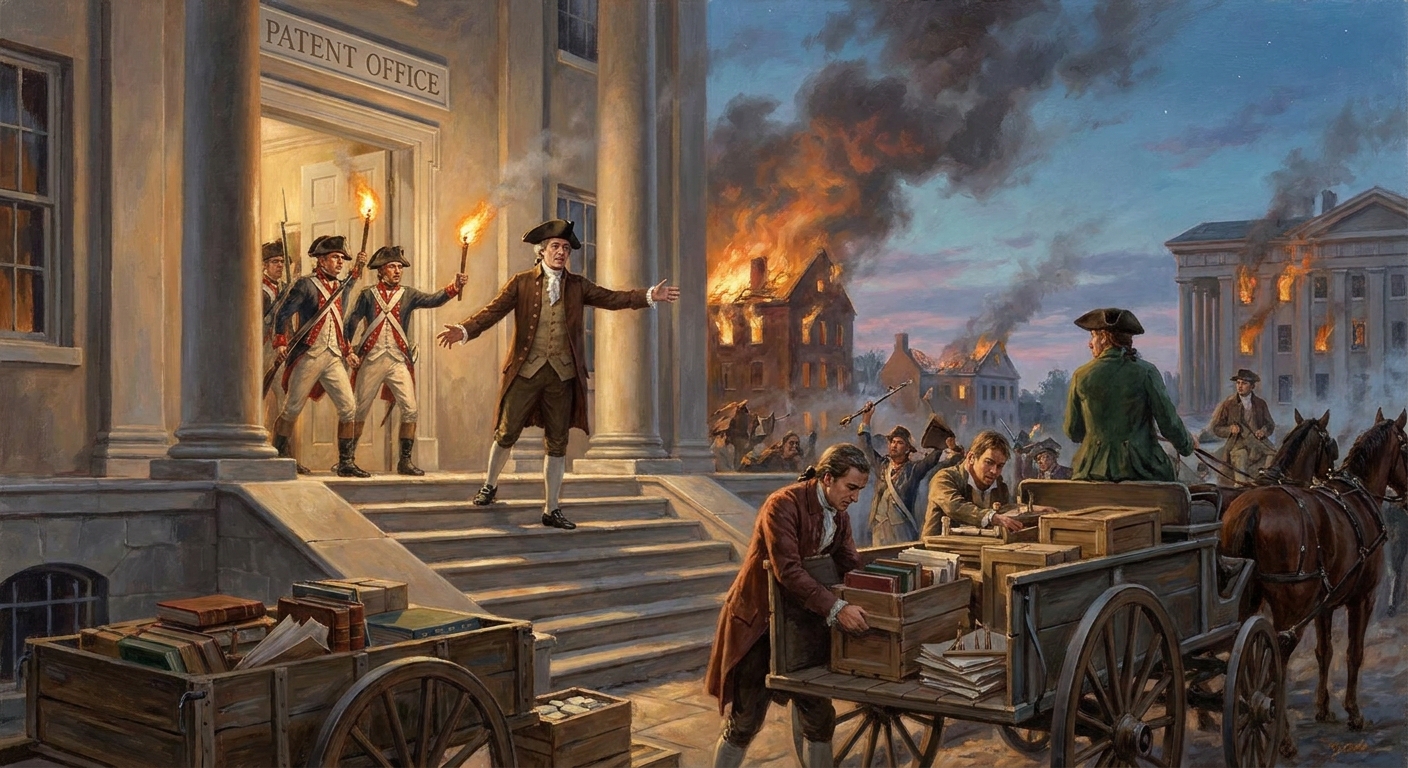
- Thornton intervenes at the Patent Office while the British are still in the city. Dr. William Thornton, the first superintendent of the U.S. Patent Office, is widely credited with persuading British officers not to burn the Patent Office collections at Blodgett’s Hotel. Accounts differ on the exact dialogue and the exact hour, but the basic fact holds: the Patent Office survives when other public buildings do not, and that survival is tied to an intervention during the occupation, not days later.
- The British begin pulling out. The raid is not an occupation. After the night of destruction, British forces start moving back toward their ships.
- Pleasonton keeps the State Department papers moving. The most important “government kept running” work is not a speech. It is the steady removal of papers that make decisions enforceable later.
It is easy to tell the story as if Washington burned and then everybody woke up the next morning with a clean plan. It did not work that way. The sequence is messier: fires, wind, smoke, people acting on half-information, and a handful of officials doing the plain work of saving what the nation cannot re-create from memory.
August 26 (Friday): A capital without offices
- Officials return to ash and locked doors. The Capitol and the President’s House are ruined. Other federal buildings are damaged or unsecured. Work does not pause, but it does scatter.
- Washington’s surviving buildings become assets to guard, not symbols to admire. Blodgett’s Hotel, housing the Patent Office, now matters because it exists. Its contents become something to secure against looting, mishandling, and the smaller fires that follow big ones.
- Government business shifts into borrowed rooms. This is the start of the patchwork period: private homes, rented spaces, and whatever can be secured quickly.
August 27 (Saturday): Custody and paperwork
- Securing the Patent Office collections becomes a real job. Once spared, they still need protection, inventory, and supervision. Survival is not the same as safety.
- Departments tighten routines. Who holds keys, where files sleep at night, which couriers can be trusted, what gets copied twice, what gets locked away. This is governance after a burn.
- The city feels both abandoned and watched. The British are gone, but their imprint is fresh, and Washington’s own confidence has been shaken.
August 28 (Sunday): Madison regroups
- Madison and the cabinet reassemble outside the ruined center. In the days after the burning, Madison moves between temporary locations while the government searches for stable ground. The immediate goal is simple: resume executive decision-making with whatever clerical support can be gathered.
- Messages begin flowing again. Riders and hand-carried dispatches resume their steady work. This is how the government breathes when buildings do not cooperate.
- The threat shifts toward Baltimore. The raid on Washington is a blow, but it also concentrates American attention on what Britain might try next along the Chesapeake.
August 29 (Monday): Armstrong falls, and the capital question hardens
- Secretary of War John Armstrong’s position collapses. Blame settles hard after a humiliation like Washington, and Armstrong becomes the most visible target inside the administration. His resignation comes in this immediate aftermath, when the government needs to show accountability as well as resilience.
- Whether to leave Washington becomes policy, not sentiment. There is debate, anger, and talk of relocation, but the drive to rebuild in place gains strength because leaving looks too much like surrender.
- Document security becomes more than good habits. The event teaches a harsh lesson: papers are power, and power needs locks and routines.
August 30 (Tuesday): Temporary governance, real decisions
- The executive branch begins operating out of temporary quarters, including the Octagon House. The Octagon becomes a practical headquarters for Madison in the aftermath, a reminder that legitimacy can live in rented rooms if the decision-making continues.
- Reconstruction becomes procurement. Rebuilding is not a single “groundbreaking moment.” It is contracts, materials, labor, and the question of wartime money.
- War planning continues. While Washington sweeps up, commanders and planners have to look toward Baltimore and beyond.
August 31 (Wednesday): Temporary governance becomes routine
- Daily procedures harden. When the usual offices are gone, routines change: where documents are stored at night, how letters are routed, who holds what keys, which couriers can be trusted.
- Congress and clerks face a logistical problem, not just a political one. A legislature needs rooms, records, and a way to publish and circulate its acts. That infrastructure has to be rebuilt as much as the walls do.
- The story widens past Washington. The burn is a symbol, but the war remains a network of fronts, ports, and supply lines. The capital’s crisis does not replace them.
Early September 1814: Recovery under a shadow
- Washington recovers while Chesapeake operations continue. The British are not finished, and American leaders know it. The pressure shifts toward Baltimore.
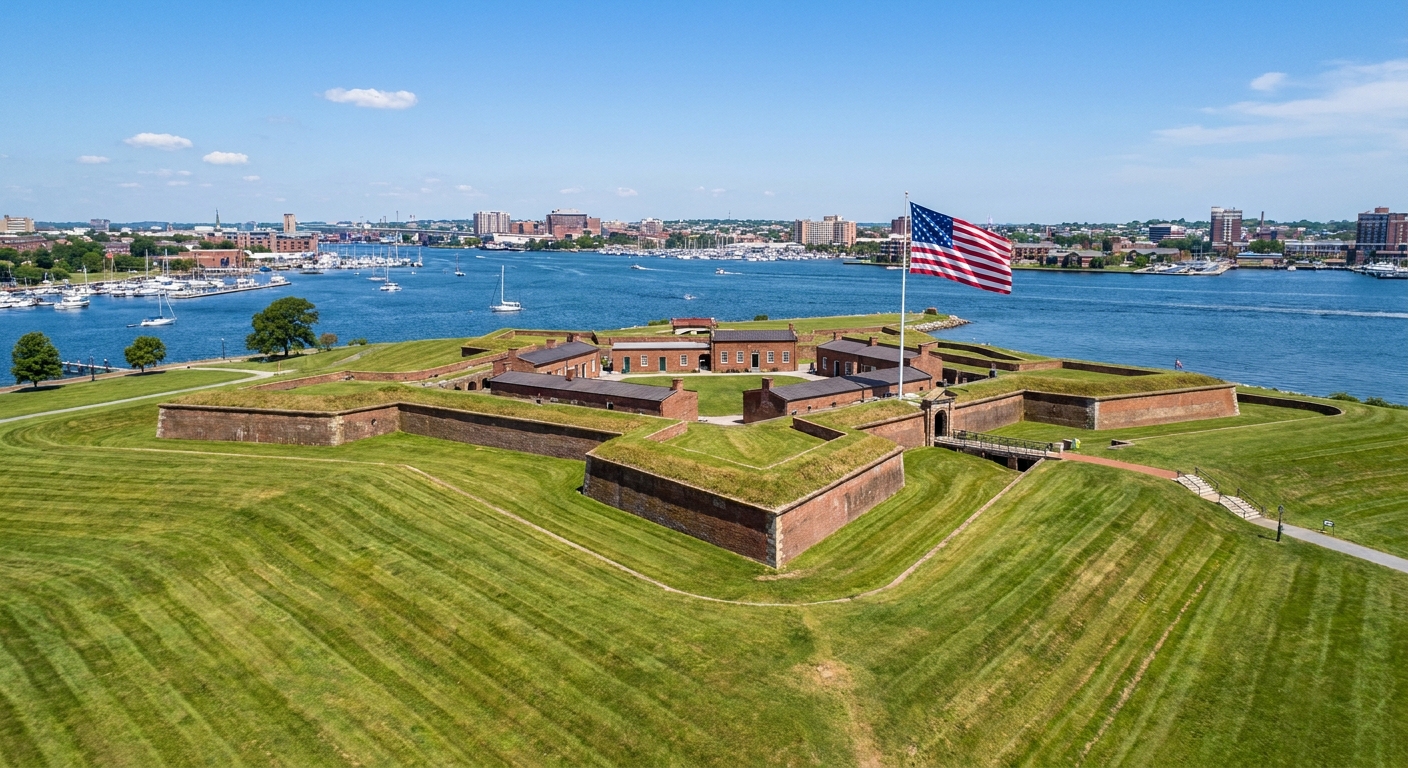
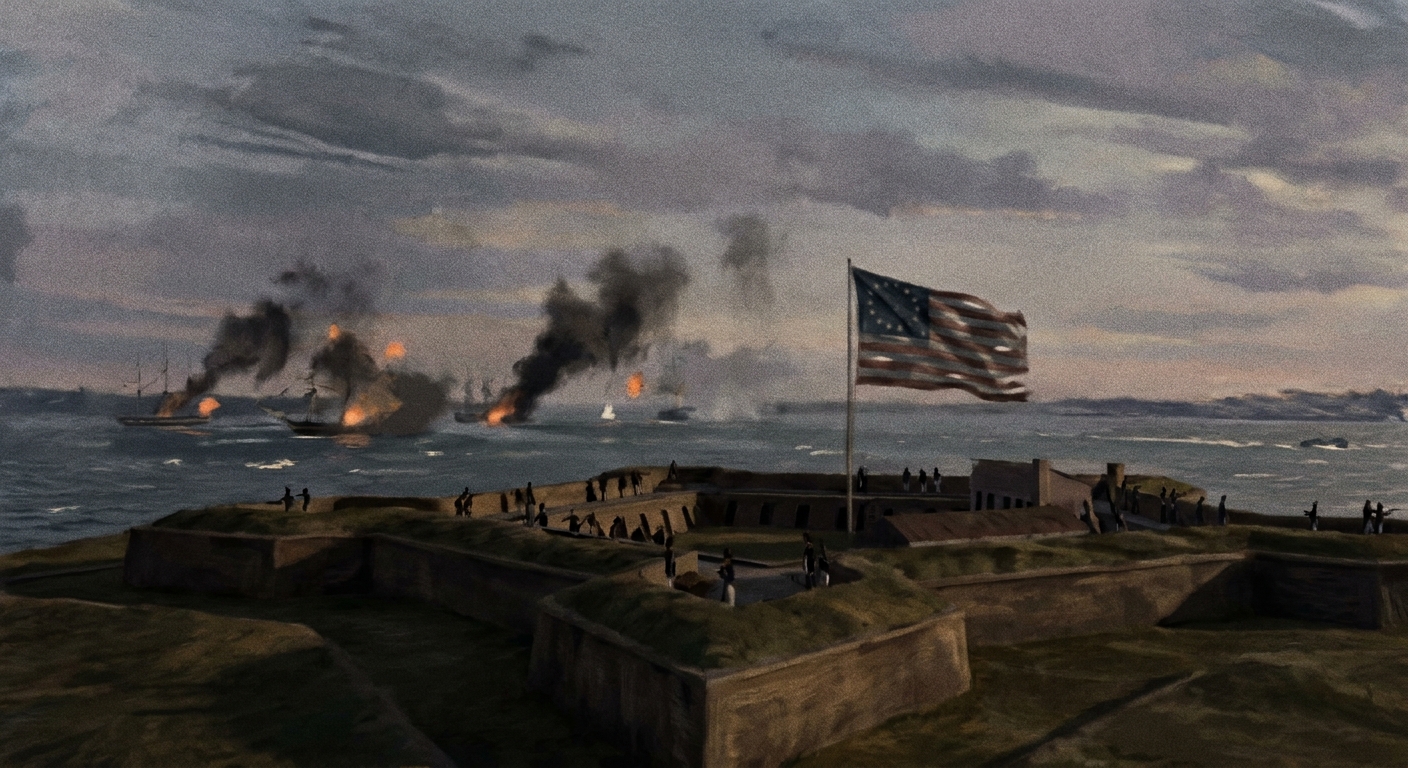
- Fort McHenry becomes the next test of nerve and planning. The capital can be scorched and still function, but the region cannot afford a string of successful British blows.
For the Baltimore side of the story, including why the British bombardment did not achieve its goals, see: Fort McHenry: Why the Bombardment Failed.
How government kept running
When people ask how the U.S. government “kept functioning,” they are often imagining a single decisive meeting. In truth, it was a stack of smaller, practical choices made by people who understood what mattered most.
1) Save records, not furniture
The physical objects of power can be replaced. The documentary proof of power is harder to reconstruct. That is why Pleasonton’s evacuation of State Department papers to Leesburg matters as much as any speech. Correspondence, accounts, treaty files, commissions, and working ledgers are what let decisions stand up later.
2) Disperse to survive
In a raid, concentration is vulnerability. Scattering key papers and personnel reduced the odds of a single catastrophic capture or loss. It also made coordination harder, but survival came first.
3) Protect the collections that cannot be rebuilt
Thornton’s stand at the Patent Office is a useful example because it shows a different kind of preservation. Not every “record” is a diplomatic letter. Some are models, inventions, and technical files that represent years of work that cannot simply be rewritten from memory.
4) Reassert legitimacy by showing up
Returning to Washington and continuing official business there mattered. Even when Madison worked out of temporary quarters like the Octagon House, the point was not comfort. It was continuity. The raid did not get to decide where the republic governed from.
What rebuilding looked like
If you are picturing scaffolding rising the next morning, set that aside. Immediate rebuilding in 1814 was closer to what you would see after any sudden disaster in a town that still needs to eat, travel, and communicate.
- Clearing and securing damaged buildings so people could safely retrieve what remained.
- Locating suitable temporary rooms for departments and clerks, then setting rules for access and storage.
- Restarting correspondence so orders and information could flow to military commanders and regional officials.
- Planning permanent rebuilding while also managing wartime budgets and political pressure.
And all of it was done by human beings who were tired, embarrassed, angry, and still expected to show up and do the work. That is the part I always want to underline. Wars are not only fought in fields and on water. They are endured in offices, kitchens, and borrowed rooms where someone tries to keep a nation’s paperwork from blowing away.
Recap
- Aug 24: defeat at Bladensburg opens the road. Washington burns. The government evacuates what it can.
- Aug 25: severe storm hits. The British begin withdrawing. Thornton’s intervention helps spare the Patent Office collections. Key records keep moving toward safety.
- Aug 26 to Aug 31: salvage, resignations, and relocation into temporary quarters including the Octagon House. The political fight shifts to rebuilding in place versus moving the capital.
- Early Sept: Washington rebuilds while the war continues, with Baltimore and Fort McHenry becoming the next test.
Walk the context
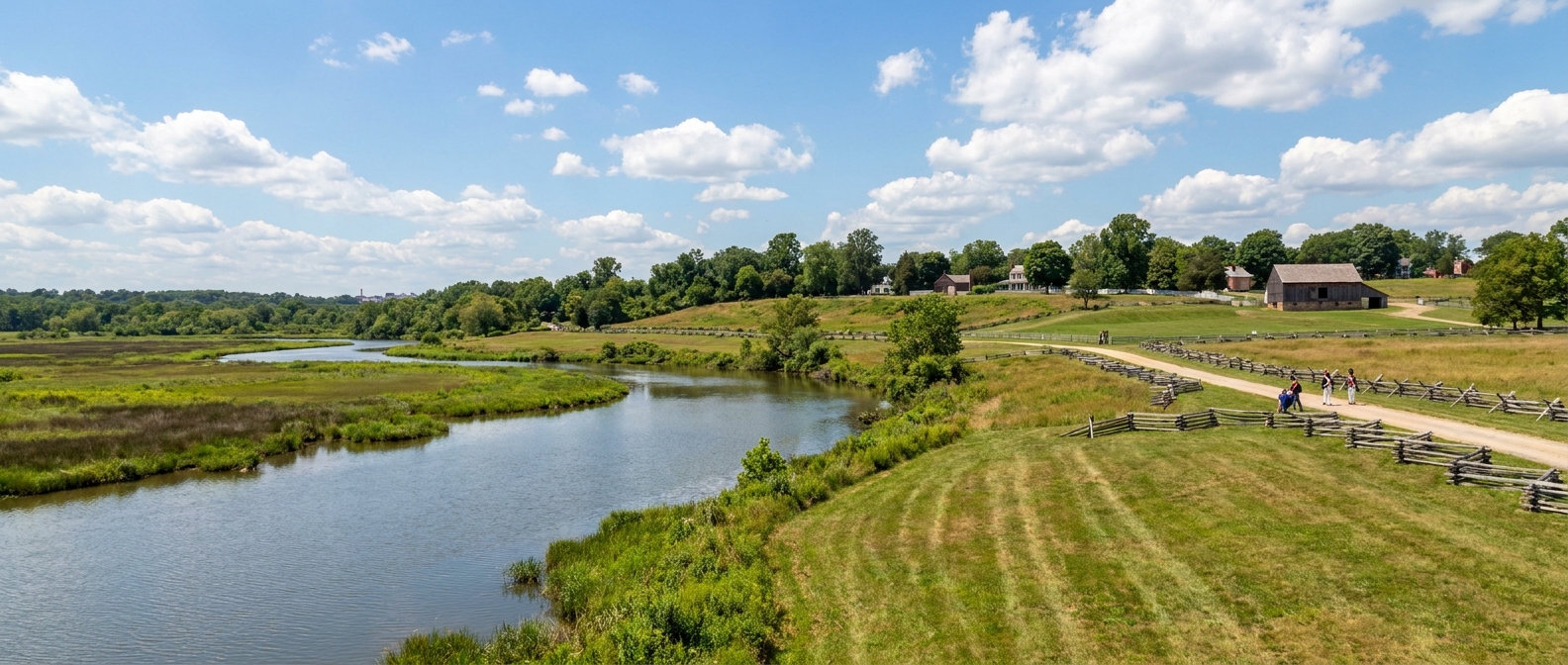
Washington’s 1814 landscape is hard to see under the modern city, but the wider campaign terrain still speaks if you walk it patiently. I keep a growing hub of chronological reading here: Guide: Timeline. For campaign context, these two are the best companions to this article:
- Beyond the Bladensburg Races for how the road to Washington was opened.
- Fort McHenry: Why the Bombardment Failed for what came next and why the British offensive stalled in Maryland.